

Detecting Stone...
02/21/16
It is not what we usually seek, makes us proud and happy most of the time, but what we find! The same is true for me. I always think of finding some rare coin or jewelry, but all the time I get surprised by things concealed in the ground. This story began during a month-long expedition to the Mongolian border, where we searched for the 17th century artifacts and medieval Chinese coins. I had my reliable and precise X-TERRA 705 with me.
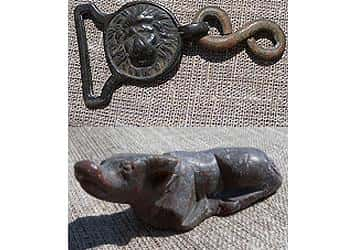
My partner was searching on one side of the small hill, where an old house, presumably a 19th century one, once used to be. And I chose the “wrong” side. Soon he started digging out coin after coin, old Chinese cast coins with square holes in them. He was happy and started teasing me, while I was completely concentrating on some strange and complicated signal. It sounded like both iron, cast iron and bronze. So, as we often say, a shovel is the best discrimination mask you have! My signal turned out to be a piece of old cast iron cooking pot, two forged nails and a Russian naval officer belt buckle, mid 19th century.
To tell you the truth, I was shocked! My research as an amateur historian is connected with the Russian navy and merchant fleet activity in the Far East before 1905, and here, 3 thousands kilometers from the sea I uncovered a small piece of Naval history. All my partners gathered around, we started guessing how it got there, and decided that it was the house of a retired Naval officer, who brought a string of Chinese coins (from the other side of the house) from one of his voyages as a souvenir.
After initial excitement was gone and all the coins, as my friend thought, were also dug out, I was left alone on that hill. Something stopped me from leaving. I was hoping to find some other piece of that historical puzzle, to get another piece. So I walked to the spot where Andrey found 14 coins in a string. A faint signal came from my X-TERRA 705, like a coin rather deep or some encircled metal object. Hmm, another coin with a hole?! Why not! I got on my knees and took out some soil. The signal was so faint, barely distinguishable. After a minute or two of digging I started taking ground out of the hole with my hands and grabbed something that was not metal at all! It was a stone figurine of the dog, lying relaxed, looking at its master. It was so well carved and beautiful, words cannot express all the joy, adrenaline and satisfaction I felt that moment! It was an oriental figurine, probably bought by a naval officer in Japan or China in the first part of the 19th century. But what gave the metal signal?! Underneath the figurine was another nail, bent to form a circle. Call it whatever you want, I call it Fate.
Now all finds from that house are on display in the Museum of the Maritime State University, in Vladivostok, where I teach cadets free from metal detecting time.